Corporate Party or Wedding: What Actually Changes for the Music
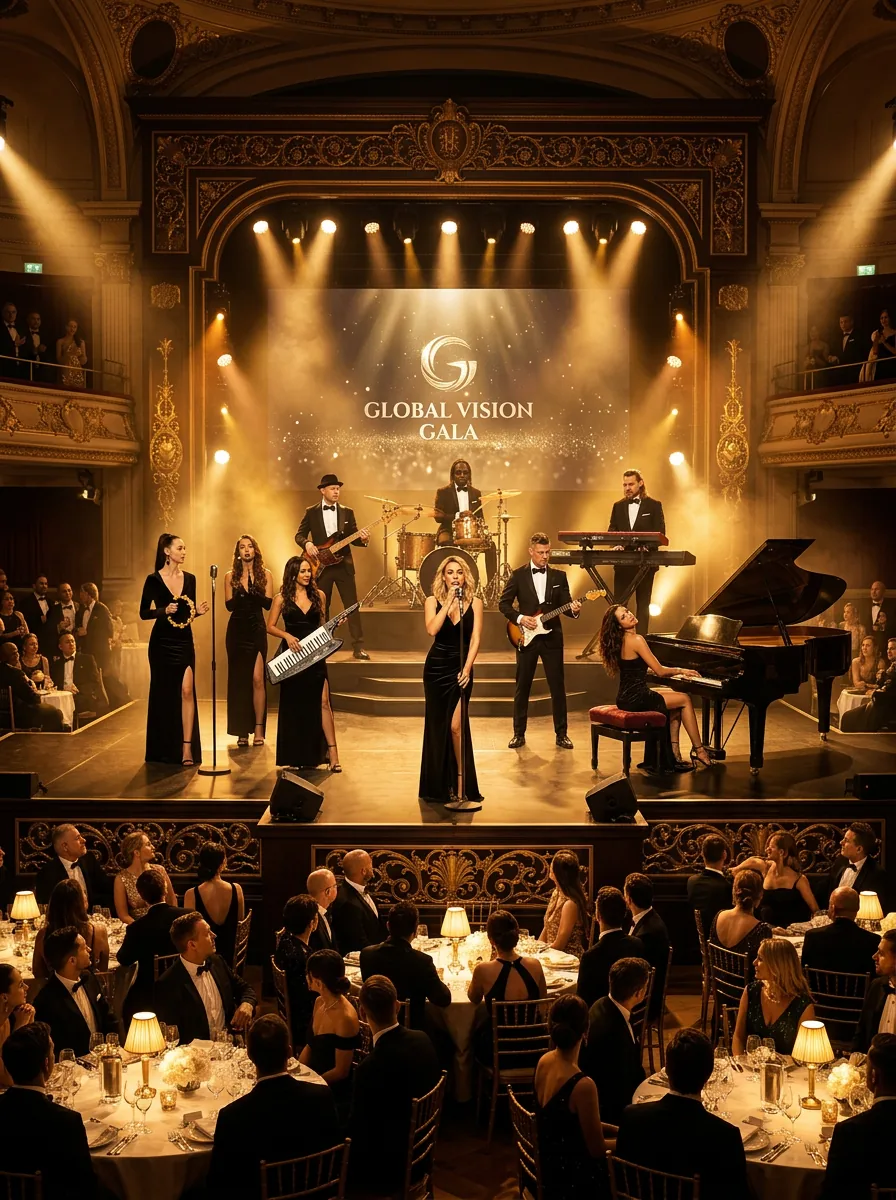
Anyone planning a corporate party shortly after organising a wedding tends to reuse what worked last time: the same line-up, the same running order, a similar set list. That goes wrong more often than it should — the music is no worse, the brief is simply a different one. Almost everything else follows from that single difference: the volume during dinner, the length of each set, the moment the dance floor opens, even which songs can be played at all. Here are the differences that genuinely matter in planning.
The brief is a different one
A wedding is about two people and their story. The music carries an emotional arc with a clear protagonist: the couple. Every song is allowed to point at those two, and the more personal it gets, the better the evening holds.
A corporate party is a company saying thank you, representing itself, sometimes both. The audience consists of colleagues, often joined by guests, partners or clients. Nobody stands at the centre, and when somebody is singled out — during an award, say — it happens inside a fixed programme slot rather than through the music. The band therefore has a different role: it carries the evening without owning it. Grasp that one point and most of the remaining decisions make themselves.
The audience sits differently in the room
At a wedding the age range runs from children to grandparents. Everyone knows everyone, or is at least connected through the couple, and willingness to join in runs high — guests came to celebrate and all of them know it.
At a corporate party, hierarchy is present in the room. That is no criticism, merely a fact: many guests dance only once their superiors do, or once those superiors have left. Colleagues would rather not be remembered on Monday as the first person on the dance floor. For the set list that means the entry into the party block has to be broader and more familiar than at a wedding, so the first guests blend into a group instead of standing out. For timing it means the dance floor opens when the room is ready, never because a schedule says so.
- Wedding: one group, one occasion, high willingness to join in from the first minute
- Corporate party: several groups watching each other, plus guests from outside the company
- Consequence: a broader entry into the party block, more patience while building it, no pressure onto the dance floor
Running order: an arc against blocks
A wedding has one continuous arc. Ceremony, reception drinks, dinner, first dance, party — the band accompanies the whole day and can carry the evening from one point to the next.
A corporate party is built differently. Welcome, the speech from the management, often awards or long-service recognitions, the buffet opening, further programme items, then the party. The band plays in blocks between those items, and it has to be able to stop on a signal at any moment. That is the craft of it: a set that only works as a whole is the wrong set for a corporate party. So we plan blocks that can end at any point without sounding cut off.
- Wedding: a continuous arc across the day, transitions owned by the band
- Corporate party: defined blocks between speeches, awards and the buffet opening
- Every block has a planned exit plus a short emergency exit
The speech sets the clock
The most important moment of a corporate party is not a musical one. It is the speech from the management, and it decides how the whole evening is remembered. Anyone still rigging equipment during that speech, starting a set too early, or running a microphone that feeds back, destroys it — and the room remembers that far longer than any song.
Technically this is solvable, but only in advance:
- Cue sheet: every programme item gets a signal and a named person responsible. The band starts on a cue, not on instinct
- Sound check before guests arrive: finished before the first guest enters the room, not alongside the reception
- The speech microphone on the same system: one rig, one engineer, no second radio link colliding with the first
- Levels agreed beforehand: speech level and music level set in advance and recallable separately
At a wedding, a speech is a lovely moment. At a corporate party, it is the reason the technical setup has to be finished an hour earlier.
Volume sits lower than most people expect
During a wedding dinner the band plays in the background so table conversation stays possible. The same holds at a corporate party, with something added on top: here people also talk business. A colleague walks a client through a project, two departments settle something that has been open for months, somebody meets the new leadership for the first time. For many guests those conversations are the actual reason they came.
So during the meal at a corporate party we play more restrained than most organisers initially think is right. The payoff arrives later: leave room during dinner and the full weight is still available for the party block. Go loud early and there is nothing left to add at the end.
Who decides on the other side
At a wedding the couple sits at the table and decides by instinct. They are entitled to: it is their day, their money, their memory. That is why wedding conversations run on mood, on favourite songs, on a feeling that is hard to put into words.
On the corporate side, the person briefing you is almost never the person who will be dancing later. It is the assistant to the management, the marketing team, internal communications, or an event agency. Those people are not spending their own money, they are spending an approved budget, and they carry the internal risk for the evening. Good work on that side is not measured by the set list; it is measured by the absence of surprises.
For a band playing a corporate party that means the charming wedding sentence — let us see how the evening goes — turns into a problem. What is needed instead is material that can be forwarded, approved and ticked off:
- A binding quote covering line-up, playing time, blocks and itemised additional costs, leaving nothing to be sorted out later
- A technical rider the venue's house technicians can read: power routing, stage dimensions, monitoring, the space required for the FOH position
- One named contact plus a phone number for the event day rather than a shared mailbox
- Predictability instead of surprise: a running order known in advance is a running order that can be defended internally
None of that is romantic, and it is the real difference in how the work gets done. A wedding buys a feeling. A corporate party also buys the certainty that the evening will run the way it was described.
House rules and house technicians have to be asked
Weddings often happen in rooms built for celebrating: a country estate, a castle, a winery, a hotel ballroom used to long nights. A corporate party happens where the company sits, or where it wants to present itself — such rooms usually arrive with a rulebook.
In practice that means house rules prescribing level limits or a limiter inside the in-house system. A works council with a say over events for employees, finishing times included. Night-time quiet rules in an industrial park, or a residential neighbourhood that tolerates no open-air stage after ten. House technicians working fixed windows for delivery, load-in and load-out, sometimes with a goods lift that is unavailable for part of the evening. An open air such as the CONET summer party at Kunstrasen Bonn follows different rules from a grand-hotel ballroom like the Hôtel de Paris in Monte-Carlo, where the AS Monaco Christmas party took place.
None of these is an obstacle as long as it is known before the booking is confirmed. Every single one becomes an obstacle once it surfaces on the event day. So we ask about them in advance instead of assuming it will sort itself out on site — which is also why PA, room sound and lighting usually run through the organiser or the venue, agreed beforehand with the house technicians.
The band is part of the brand's appearance
At a wedding a band is allowed to look like a band. It belongs to the celebration, and a degree of stage presence is part of the pleasure.
At a corporate party the same live band stands in a branded room. There is a stage design, often an LED wall carrying company content, a lectern, logos, a colour scheme. Inside that frame the band is one element of the company's appearance rather than the lead act. Clothing therefore gets agreed beforehand: understated, matched to the dress code of the guests, never more conspicuous than the occasion asks for.
The same applies to the show. A lighting production that outshines the management during a speech, or an entrance that rolls over a long-service award, works against the evening. The rule is simple: before and between programme items the band steps back, during the party block it may step forward. Reverse that and you end up with a good band plus an unhappy board.
A hard finish moves the peak
Weddings often end open-ended or very late. Corporate parties frequently have a hard finish: the shuttle leaves at one, the hotel contract ends at midnight, or people are back at work the next morning. That limit is not negotiable, and it changes how the programme is built.
The peak has to arrive earlier. The strongest half hour belongs before the end rather than after it, and if speeches, awards and the buffet leave room for only two party blocks, their order and their length are settled beforehand. So we build the evening backwards from the finishing time instead of forwards from the start.
Song selection gets broader, not more personal
At a wedding we work from the couple's requests. There is a song that means something, there is the first dance, and both are allowed to be deeply personal — that is precisely what makes the moment.
At a corporate party the opposite applies. No song may embarrass anyone. Lyrics that are harmless in private land badly in a company context: songs about getting fired, about bosses, about break-ups or about drinking read differently from a stage than from a car radio. At larger corporations there is an internationally mixed audience in the room as well, for whom a German-language sing-along block does not work.
Selection therefore gets broader and safer, not more personal. That is no limitation, it is craft: there is plenty of repertoire that reaches three generations and four nationalities at once without turning generic. Special requests get discussed beforehand, and when a title carries risk in a company context, we say so before it reaches the list.
Line-up and budget
The line-up follows the room, the guest count and the programme rather than the occasion. The tiers are identical for a corporate party and a wedding:
- Duo (reception, dinner, smaller celebrations): from around 2.600 EUR
- Duo with DJ (dinner plus a long party block from one source): from around 3.800 EUR
- Large line-up with horn section and show programme: up to 25.000 EUR net
Travel and accommodation are excluded from those figures and stated transparently in the quote. The difference between the two occasions lies less in the price than in the playing time: a wedding often books the whole day, a corporate party two or three shorter blocks across the evening.
How a live band is actually costed — line-up, playing time, travel, plus what a proper quote should contain.
What a live band costsWhat stays the same for both
The technical standard does not change with the occasion. The same applies to a corporate party and a wedding: backline at concert standard, in-ear monitoring, our own FOH engineer. PA, room sound and lighting are usually supplied by the organiser or the venue; we agree all of it in advance with the house technicians. On request, Gemini Music supplies the complete system for an additional fee.
This point is the most common source of error in planning. Assume the band brings the sound along, then discover on the event day that the room has no PA at all, and you lose time nobody has. The question of which rig is already on site and what has to be added belongs before the quote rather than in the load-in.
Where this comes from
The points above come from evenings of exactly this kind rather than from a handbook:
- The Vodafone Christmas party — an evening built around a programme section, dinner and the party afterwards
- The Christmas party of the basketball club AS Monaco at the Hôtel de Paris Monte-Carlo — booked three years running for that evening, a classic grand-hotel ballroom with corresponding requirements on levels and load-in
- The CONET summer party at Kunstrasen Bonn — more than 2,000 guests, a large stage, open air
- Stahlgruber 100 years in München — a company anniversary rather than a Christmas party: here awards and a look back define the programme
- The VCI gala dinner — an association audience, speeches at the centre, music in clearly defined blocks
What those evenings have in common: the more programme an evening carries, the more the briefing matters and the less the length of any single set does.
In short
- The brief differs: a wedding tells a story, a corporate party says thank you or represents
- Hierarchy in the room shifts the moment the dance floor opens
- The band plays in blocks between programme items and stops on cue
- The speech sets the clock: cue sheet, sound check before guests arrive, one microphone on the same system
- Play more restrained during the meal, keep the weight for later
- A hard finish means the peak has to come earlier
- On the client side an assistant, a marketing team or an agency decides — against approvals and risk rather than instinct
- House rules, works council, night-time quiet rules and the technicians' time windows get asked about in advance
- The band is part of the brand's appearance: understated before and between programme items
- Song selection gets broader and safer, not more personal
- Technical standard and responsibility for PA and lighting are identical for both occasions
Live band or DJ at a corporate party — when each one carries the room, and how both get sequenced across one evening.
Live band or DJFormats, line-ups, venues and logistics for corporate events — all on one page.
Corporate party bandPlanning the year-end celebration? Running order, repertoire and booking windows for the Christmas party.
Christmas party bandIf it does turn out to be a wedding after all: line-ups, running order and repertoire for the day itself.
Book a wedding bandMusic for the ceremony and the drinks reception — the quiet part of the day that often gets underestimated.
Ceremony & reception musicSend us the date, the venue, the guest count and the planned programme — especially speeches and awards. You will get a line-up recommendation back, along with a run of show built around your programme rather than against it.
Plan your event with Gemini Music
Secure an exclusive consultation for your next event. We craft a tailored sonic concept for the highest standards.
Make an Inquiry